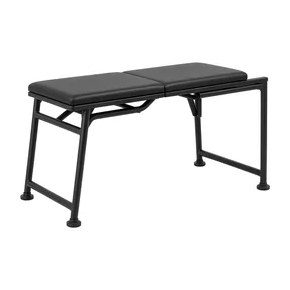
PEPE Mobility Bath Transfer Bench
Black bench with two legs inside the bath and two outside, so the user sits down outside the bath and slides across. A good, plain first bench at a fair price.
A bath transfer bench is a long seat that sits half inside and half outside the bath, so you can sit down outside the tub and slide across over the side without stepping over it. It is one of the simplest ways to keep using a bath with a shower over it when stepping in is no longer safe.
Two legs stand on the bathroom floor and two stand inside the bath, with the seat bridging the bath wall. You sit on the outside end, lift your legs over the side, then shuffle or slide along to the inside end, where you shower sitting down. To get out, you reverse the move. Most benches have a backrest, and many have a handle or arm on one side to hold while sliding.
A bath board rests across the rim of the bath and has no legs. It is smaller and cheaper, but you sit on the rim height and must already be inside the bath footprint once seated. A bench stands on the floor, so you sit down fully outside the bath first, which helps people who cannot lift a leg over the side while standing. Benches take up more space and need room on the floor beside the bath.
| Point | Transfer Bench | Bath Board |
|---|---|---|
| Where you sit down | Outside the bath | On the rim |
| Backrest | Usually yes | No |
| Floor space | Needs space beside the bath | Fits within the bath |
| Typical user | Cannot step over the bath side | Can step over, but needs to sit to wash |
A bench suits people who can sit unsupported and shuffle sideways, but who cannot safely lift a leg over the bath while standing. That includes many people with hip or knee problems, those recovering from joint replacement and people whose balance has become unreliable. It also suits wheelchair users who can move sideways from the chair onto the outer end of the bench, provided there is room to park the chair alongside. People who cannot sit up without support, or who need to be lowered into the water, usually need a bath lift or hoist instead, and a level-access shower may be the longer-term answer.
Basic benches have a fixed plastic seat and a backrest that can be fitted on either side to suit the bath. Padded benches are warmer and softer. Sliding bath transfer bench designs have a seat that glides along a track, so the user stays seated while the seat carries them across, which helps people with weaker arms or fragile skin. Some benches have a cut-out in the seat for washing and a commode option.
An occupational therapist can show you the technique and check that the bench suits your bath. Our transfer aids guide explains how benches fit with other equipment.
Measure the bath width at the rim and at the base, the height of the bath wall, and the floor area beside the bath. Rolled-edge, freestanding and very narrow baths can be a problem, and a bath panel with a deep lip may stop the outer legs standing straight. Check the leg height range on the listing against your bath height so the seat ends up level.
Because part of the bench sits outside the bath, water can run along the seat onto the floor. Tuck the curtain between the seat and the backrest, or use a curtain with a split. A hand-held shower head pointed inwards keeps most of the water in the bath. Put a non-slip mat outside the bath and dry the floor after each use.
Transfer benches are often supplied on loan by community equipment services after an occupational therapy assessment. You can ask your council for a needs assessment. Buying privately is common if you want a padded or sliding design, and disabled buyers can usually claim VAT relief.
The benches below were in stock when we checked each listing, and they cover basic, padded and sliding designs.
Usually not. A fixed glass screen blocks the bench from bridging the bath side, so it suits baths with a curtain.
Most benches let you fit the backrest on either side, so it can face the taps or the wall to suit your bath.
The legs have rubber feet or suction tips, but keep the bath floor clean and check the feet for wear.
Some local equipment services and private hire shops lend them, which can make sense for a short recovery.
Yes, that is how most people use one. Tuck the shower curtain inside the bath but over the bench seat, so water runs back into the bath rather than onto the floor. A hand-held shower head makes washing much easier while seated.
Black bench with two legs inside the bath and two outside, so the user sits down outside the bath and slides across. A good, plain first bench at a fair price.
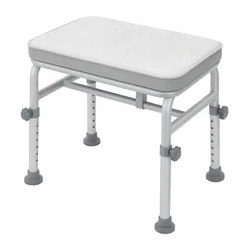
A padded, adjustable bench from a long-running UK daily living brand. The padding helps if sitting on hard plastic is uncomfortable, and the frame is light enough to lift out between baths.
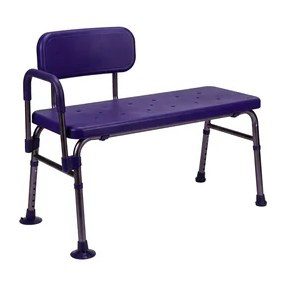
Height-adjustable bench, useful where the bath sits higher or lower than usual. One of the lower-priced benches here, with a plain plastic seat that is easy to wipe down. Measure the bath rim height before ordering.
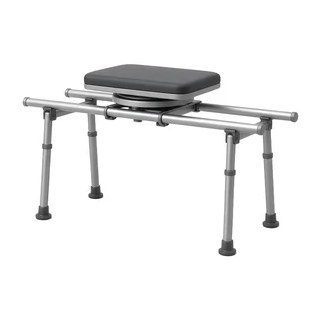
The seat slides along rails and swivels, listed for users up to 204 kg. A carer can move the seat across rather than the user shuffling, which suits people with little upper body strength.
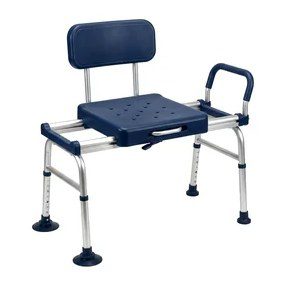
Sliding and swivelling seat listed for users up to about 150 kg, with a frame that adjusts for height. It costs less than the other sliding benches here, so it is worth comparing if a sliding seat is needed.
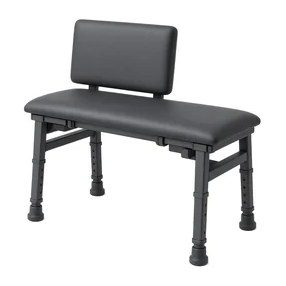
Sliding swivel seat with armrests and a safety belt, at the top of the price range. The arms give something to push from when standing up again. Check the overall width fits beside the bath, as sliding benches reach further into the room.
Great as a gift or an upgrade when shopping for vevor fold up shower bench.